
If you run a furniture program, a mattress chain, or an Amazon storefront, the electric adjustable bed base category is one of the highest-margin SKUs you can carry — and one of the easiest to get wrong. A returned base costs you 3–4x the gross margin of a flat foundation, so getting the specs right before the PO goes out is what separates a profitable program from a CX nightmare.
We build adjustable bed bases for retail and OEM buyers out of our Vietnam facility, and we see the same sourcing mistakes repeated across new programs every quarter. This guide walks through what an electric adjustable bed base actually is at the component level, how to read motor configurations, the structural specs that quietly drive your return rate, and the compliance paperwork your channel partner is going to ask for.
What an Electric Adjustable Bed Base Is, at the Component Level
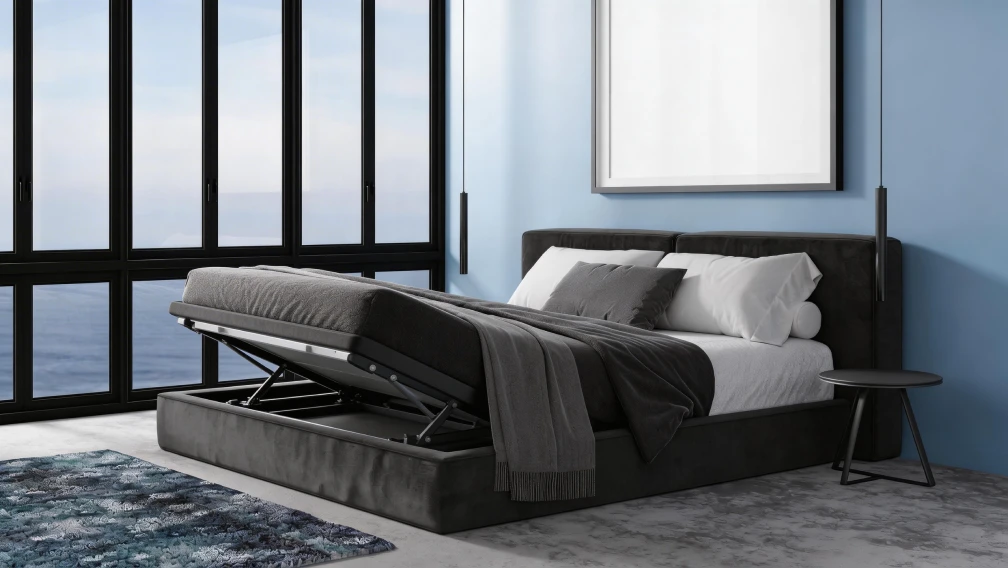
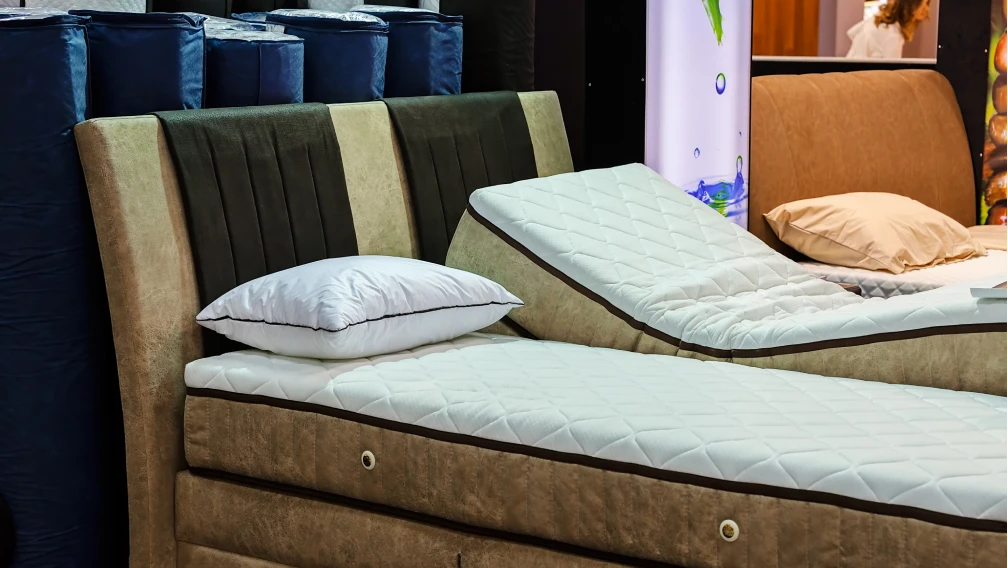
An electric adjustable bed base is a powered mattress foundation. It articulates at the head and (in most cases) the foot, sometimes also at the lumbar and pillow zones, using one or more linear actuator motors controlled by a wireless remote or app. The mattress sits on top — no box spring needed.
What's actually inside the deck of a typical adjustable base:
- Steel frame — welded, powder-coated, usually 1.0–1.5 mm cold-rolled
- Articulation panels — hinged deck sections (head, lumbar, seat, thigh, foot)
- Linear actuator motors — 1, 2, 3, or 4 depending on configuration
- Control box — receives remote signals and routes power to motors
- Wireless remote — RF 2.4 GHz is the current standard; older designs still use IR
- Power adapter — typically 29V DC, 2A
- Optional modules — massage motors, USB-A/USB-C ports, under-bed LED strip, app/Bluetooth board, battery backup
The retail price gap between a $499 base and a $1,400 base is mostly explained by motor count, motor brand, frame steel weight, and which optional modules are factory-installed. Once you can read those four variables on a spec sheet, sourcing gets a lot more predictable.
Motor Configuration: The Most Important Spec for Your Program
Motor count is where retail SKU strategy lives. It dictates the price tier, the marketing claim, the warranty risk, and the customer demographic. Here's how the three configurations we manufacture map to actual retail use.
Dual-Motor (Two-Motor) Bases
Two motors: one drives the head incline, one drives the foot. Each operates independently, so a sleeper can sit up to read while keeping their legs flat, or run zero-gravity (both elevated simultaneously).
This is the volume tier. It covers the bulk of unit sales in the North American adjustable category and is the workhorse for e-commerce, mid-tier mattress retailers, and private-label programs targeting the $599–$899 retail price point. Head incline range is typically 0–60° or 0–65°; foot raise is 0–40° or 0–45°.
Anyone selling against Lucid, Nectar, Tempur-Ergo Smart Base, or the entry-level Leggett & Platt models is in this tier. If you're trying to hit Walmart or Costco price thresholds, this is the configuration that gets you there.
Three-Motor Bases with Lumbar Support
A third motor adds a dedicated lumbar zone between the head and seat sections. Instead of the lumbar just being a passive byproduct of head articulation, the user (or the preset) lifts the lower back independently for targeted support.
This tier matters for two reasons. First, it lets the marketing claim move from "ergonomic" to "clinically-aligned" or "lumbar-supported," which adjusts customer perception about price. Second, it's the configuration that healthcare-adjacent buyers — assisted living distributors, home care programs, premium hospitality — actually want, because it solves real pressure-management problems for users who spend long hours in bed.
Expect retail pricing of $899–$1,299, weight capacities of 800–900 lbs, and feature sets that typically include app control, Bluetooth, programmable memory positions, and battery backup.
Four-Motor (Quad-Motor) Bases
Four motors split the deck into four independently controlled zones: head, pillow tilt, lumbar, and foot. The pillow-tilt motor adds a small angle adjustment at the head section so the user's neck stays aligned when the head incline is steep.
This is the premium tier — $1,200–$1,900 retail. The buyer here is typically a luxury mattress retailer, a high-end furniture chain, or a smart-bed brand. The Home Depot OS65 series, premium Beautyrest Black bases, and most "smart bed" programs sit at this level.
Side-by-Side Comparison
| Spec | Dual-Motor | Three-Motor | Quad-Motor |
|---|---|---|---|
| Articulation zones | Head, foot | Head, lumbar, foot | Head, pillow tilt, lumbar, foot |
| Typical head incline | 0–65° | 0–65° | 0–70° |
| Typical foot raise | 0–45° | 0–45° | 0–45° |
| Weight capacity | 650–750 lbs | 800–850 lbs | 850–900 lbs |
| Common retail price (Queen) | $599–$899 | $899–$1,299 | $1,200–$1,900 |
| Best fit channel | Mass retail, e-commerce, mattress chains | Premium retail, home care, hospitality | Luxury, smart-bed brands |
| Typical warranty | 5–10 yr limited | 10 yr limited | 10–15 yr limited |
Frame Construction and Weight Capacity: Where Return Rates Get Decided
Frame failure shows up as squeaks, mid-cycle motor stalls, deck flex when two people sit on the same side, and in the worst case a bent panel that won't return to flat. Two specs predict almost all of it.
Steel gauge. Most reputable factories use 1.0–1.5 mm cold-rolled steel for the deck sections and 1.5–2.0 mm for the structural rails. Anything below 1.0 mm in the rails will flex under a real-world load (two sleepers, hybrid mattress, body weight + bedding ≈ 500–650 lbs combined). Ask for steel thickness on the spec sheet, not just "heavy-duty steel."
Weld type and pattern. Robot-welded frames are dimensionally more consistent than manual welds, which matters when the deck has to fold along a hinge line thousands of times across a product's life. Spot density and weld penetration are inspection items in any factory audit you take seriously.
Weight capacity. Published capacities range from 650 lbs on entry-level bases to 1,000+ lbs on heavy-duty models. A useful rule of thumb: pick a capacity that comfortably exceeds the combined weight of the mattress plus the sleepers plus 20%, which gives margin for sit-on-edge load concentrations. For a 90 lb hybrid mattress and two sleepers averaging 180 lbs each, that's roughly 540 lbs of dynamic load — so a 750 lb rated base is the safe floor.
Electrical Components: Where Field Failure Actually Originates
Motors and control boxes are where adjustable bases fail in years 3–7, which is exactly the period when warranty claims hit hardest. A few things to verify on every sample:
Motor brand and source. LINAK (Denmark) and Dewert/Okin (Germany) sit at the top end and price accordingly. Richmat, Kaidi, and Jiecang are the high-volume Chinese-origin alternatives used by most volume manufacturers; build quality is good when sourced from the factories that hold UL/TUV certs, mixed when sourced through unverified channels. Get the actuator model number on the BOM, not just "quiet motor."
Motor lifespan. A quality linear actuator on a residential adjustable base runs reliably for 10,000–20,000 full cycles, which in normal household use is 8–15 years. Cheaper bushings and brush-type DC motors drop that to 3–5 years.
Control box. Look for surge protection, thermal cutoff, and a separate fuse on the AC input. App-controlled units add a Bluetooth board that should be FCC-certified separately.
Remote. RF wireless is the current standard. The cheap failure mode is signal interference in multi-unit residences — verify the remote's pairing protocol if your channel is multifamily housing or hotels.
Battery backup. Optional, but valuable for retailers serving older customers. A backup allows the bed to return to flat during a power outage, which is a real safety issue for any user who can't get out of an inclined bed unassisted.
Compliance Paperwork Your Channel Will Demand
This is the section that derails new programs more than any other. Adjustable bed bases sit at the intersection of furniture, electrical equipment, and (when paired with a mattress) bedding flammability regulation. The documentation you need depends on the channel:
| Document | Required For | What It Covers |
|---|---|---|
| UL 962 or ETL listing | Any U.S. retail channel selling electrical furniture | Electrical safety of the base, motor, and control box |
| FCC Part 15 | Wireless remote and Bluetooth modules | Radio frequency emissions |
| California Proposition 65 | All California sales | Disclosure of listed chemicals |
| 16 CFR 1633 | The mattress sold with the base (not the base itself) | Mattress open-flame flammability |
| 16 CFR 1632 | The mattress | Cigarette ignition |
| TB 117-2013 | Any upholstered components | Furniture upholstery flammability (California) |
| ISTA 3A or 6-Amazon | Drop-shipped programs (Amazon, Wayfair) | Packaging integrity through parcel network |
| SGS / BV factory audit | Costco, Walmart, Target, Macy's | Social and quality compliance |
A common mistake: assuming 16 CFR 1633 applies to the bed base. It doesn't — that standard regulates mattress sets. But if you're shipping a base + mattress bundle, both sides need their respective certs, and the mattress will need to pass 1633 testing in the configuration it ships in (with the base or without).
How Adjustable Bases Pair with Mattresses
Not every mattress works on an adjustable base. The rule for buyers: any mattress under 14 inches thick built from memory foam, latex, hybrid (pocket coils with foam comfort layers), or air chamber construction will articulate cleanly. Bonnell-coil and continuous-coil innerspring mattresses do not flex repeatedly without damaging the springs and should not be paired with adjustable bases.
If you're bundling, also verify the mattress has a non-slip cover or your base has a retainer bar at the foot — otherwise the mattress slides toward the head during repeated articulation, which generates returns.
What Drives Cost — and What Doesn't
Three things actually drive landed cost: motor count (and motor source), frame steel weight, and optional modules (massage, app, battery, USB-C). Almost everything else — fabric color, leg height, remote design — has marginal cost impact and is where you should customize for brand differentiation without inflating the FOB price.
What inflates cost without proportional retail value: oversized power adapters, branded remotes when a generic one would work, premium massage modules on a value-tier SKU. These are common upsells from factories that don't understand the retail tier they're building for.
Sourcing Considerations for a New Program
A few practical numbers worth knowing before the first RFQ:
- MOQ. Standard MOQ from a competent factory is 200–500 units per SKU for an OEM build, lower for stock products with cosmetic customization. We run 200 units on dual-motor and 300 on three-motor builds.
- Lead time. 35–50 days from PO confirmation to FOB Ho Chi Minh or equivalent port, assuming materials are in stock. Add 4–6 weeks for first-article on a new design.
- Tariff. Powered furniture in the U.S. typically classifies under HTS heading 9403 (subheading varies by frame material). Tariff treatment varies by country of origin — Vietnam-origin product currently carries a different duty than China-origin under Section 301, which is one of the reasons sourcing has shifted toward Southeast Asia over the past five years.
- Container loading. Queen-size dual-motor bases load roughly 100–110 units per 40HQ container. Premium boxed sets with heavier cartons drop that to 70–80.
Talk to Our Engineering Team
If you're scoping a new electric adjustable bed base program — whether you need a turnkey dual-motor SKU for an Amazon storefront or a custom three-motor build for a private-label mattress brand — we can quote against your spec, provide samples within 25–30 days, and pull factory audit reports from our existing Costco, Walmart, and SGS files. Send your specs and target FOB to our team and we'll respond within 24 hours.
Frequently Asked Questions
What is the difference between an adjustable bed base and an electric bed?
The terms are used interchangeably in the residential market. "Electric bed" sometimes refers specifically to hospital-style beds with full height adjustment and side rails; "adjustable bed base" or "adjustable base" is the standard term for the powered foundation that supports a residential mattress.
How long does an electric adjustable bed base last?
A well-built base lasts 10–15 years. The frame and steel components typically outlast the electrical parts. Motors usually need replacement around year 8–12 with normal household use, which is one or two adjustment cycles per day. Bases used in commercial settings (hotels, assisted living) cycle more often and have shorter motor service intervals.
Do you need a special mattress for an adjustable bed base?
Memory foam, latex, hybrid, and air-chamber mattresses all work on adjustable bases. Traditional innerspring mattresses with continuous coils do not — the springs cannot flex repeatedly without damage. Most mattresses sold in the U.S. market over the past five years are adjustable-compatible, but the spec sheet or product page will state this explicitly.
What weight capacity should I spec for a retail adjustable bed base?
For a residential queen, 700–800 lbs is the workable floor. For king and split king bases serving two adult sleepers, 850 lbs is more comfortable. Capacities below 650 lbs are problematic when paired with heavy hybrid mattresses (90+ lbs) and average adult sleepers, and they generate avoidable warranty claims.
Does an adjustable bed base work during a power outage?
Only if it has battery backup. Without backup, the bed stays locked in whatever position it's in when power cuts. For retail programs targeting older customers or anyone with mobility limitations, battery backup is worth specifying — it allows the bed to return to flat so the user can exit safely.
What certifications does an electric adjustable bed base need for U.S. retail?
At minimum: UL 962 or ETL listing for electrical safety, FCC Part 15 for the wireless remote, and a California Proposition 65 statement. Amazon and Wayfair drop-ship programs also require ISTA 3A or ISTA 6-Amazon packaging certification. Costco, Walmart, and Target add their own factory audit requirements (social compliance, quality systems) on top of the product certs.
Can adjustable bed bases be customized for private-label brands?
Yes. Standard customization includes branded remote control, custom packaging and manual, fabric and leg color matching, and motor spec adjustments (quieter motors, higher weight capacity, faster cycle time). Deeper customization — app white-labeling, custom articulation profiles, integrated smart-home controls — is feasible at higher MOQs (typically 500+ units).
-

Author
Seemoon
Seemoon is a Senior Product Expert and Sleep Ergonomics Specialist. With extensive experience in the design and manufacturing of adjustable beds and smart sleep solutions, Seemoon is dedicated to sharing authoritative insights on furniture innovation, ergonomic health, and global B2B sourcing trends. All content is grounded in authentic manufacturing expertise to help global buyers make informed decisions.