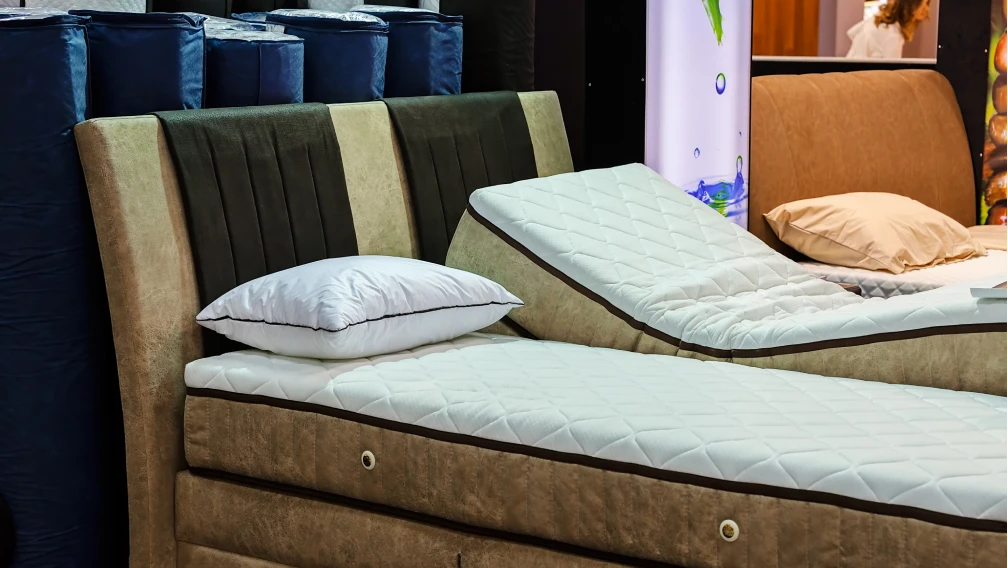


Three products get mixed up because they all change position: the consumer adjustable bed, the home care bed (also called a home hospital bed), and the acute hospital bed. The short version — an adjustable bed raises your head and feet for comfort at a fixed height; a home care bed adds height adjustment, side rails, and medical positioning for caregiving at home; a hospital bed is a facility-grade medical device built for round-the-clock clinical use. This guide breaks down where they differ on height, positioning, safety, mattress, standards, and reimbursement, and which buyer each one fits.
1. Quick definitions
All three change position, which is why buyers confuse them. Here is what each one actually is.
An electric adjustable bed frame is a consumer base that raises the head and foot of the mattress by remote. The platform sits at a fixed height off the floor, hi-low models aside, and the focus is comfort: zero-gravity presets, massage, USB charging, under-bed lighting. It comes in residential sizes through split king and looks like ordinary bedroom furniture.
A wholesale home care bed, sometimes called a home hospital bed, adds the functions caregiving needs — height adjustment, head and foot articulation, side rails, and on some models clinical tilt — while it is styled and sized for a home. Good ones are built to the same healthcare standards as facility beds but run lighter and look less clinical.
A hospital bed is a facility-grade medical device for clinical use. It carries the full set of clinical positions, a reinforced frame for round-the-clock use, locking casters, mounts for medical equipment, and on many models a bed-exit alarm. These are the beds used in hospitals, nursing homes, and rehab units, and they are designed and tested as medical devices.
2. Side-by-side comparison
The table lines up the practical differences. Use it to match a product to a channel.
| Feature | Adjustable bed | Home care bed | Hospital bed |
| Primary purpose | Comfort and sleep positioning | Medical care and caregiving at home | Clinical care in facilities, 24/7 |
| Bed height | Fixed; incline only (hi-low on a few) | Hi-Lo height adjustment | Hi-Lo height adjustment |
| Head/foot articulation | Yes | Yes | Yes, finer clinical control |
| Clinical tilt (Trendelenburg) | No | Some models | Yes |
| Side rails | No | Yes (standard or optional) | Yes |
| Casters / wheels | No | Sometimes | Yes, locking |
| Mattress | Flexible foam, latex, or hybrid | Medical or flexible foam | Medical-grade, fluid-resistant |
| Sizes | Twin to Cal King, plus split king | Home sizes; often XL twin to full | Usually XL twin; bariatric wider |
| Build / duty cycle | Residential use | Heavier; home-care duty | Reinforced for 24/7 institutional use |
| Safety standard | Consumer furniture | Should meet IEC 60601-2-52 | Medical device; IEC 60601-2-52 + FDA entrapment guidance |
| Typical channel | Retail, hotels, residential | Home care, aging in place, recovery | Hospitals, nursing homes, rehab |
| Insurance / Medicare (US) | Rarely covered | Covered if prescribed as DME | Covered if prescribed as DME |
3. Height adjustment is the dividing line
The clearest split between the three is bed height. An adjustable bed changes only your sleeping angle, and the platform stays at one height. A home care bed and a hospital bed both add Hi-Lo height adjustment: the platform rises to roughly 30 inches for caregiver access and drops to about 7 inches, or near the floor on ultra-low models, so a patient can transfer safely or fall a shorter distance. For anyone with fall risk or a caregiver doing transfers, that height range matters more than any comfort feature.
4. Safety: side rails, entrapment, and standards
Side rails prevent falls and give a patient something to hold when repositioning. They also create a gap risk: a patient can become trapped between the rail, the mattress, and the frame. That is why medical beds are designed and tested to control those gaps.
Two references matter here. In the US, the FDA treats hospital beds as medical devices, many of them Class II, and publishes entrapment guidance that maps the gap zones — commonly cited as seven — between the rail, mattress, headboard, and frame; the bed has to pair with a correctly sized mattress to stay compliant. The international standard is IEC 60601-2-52, which covers home care, nursing home, and hospital beds and tests side-rail strength... It carries the CE mark requirement in Europe and was updated to IEC 80601-2-52 in 2026. If you are aligning your inventory with these stringent regulatory markets, read our comprehensive home care bed distributor sourcing guide to optimize your institutional procurement protocol.
For a buyer, the practical line is simple. A consumer adjustable bed is not held to these rules; a home care or hospital bed should be. If you are sourcing a home care or hospital bed for a regulated market, confirm the standard the unit is built and tested to, and ask for the mattress-pairing spec.
5. Mattress and linen differences
Each bed type drives a different mattress and linen.
• Adjustable bed: a flexible mattress (memory foam, latex, or pocketed-coil hybrid) and standard household linen sizes.
• Home care and hospital beds: a medical mattress is common — a fluid-resistant or vinyl cover, antimicrobial and flame-retardant, with pressure redistribution and compatibility with alternating-pressure systems. Many use an XL twin that needs special fitted sheets, and bariatric models run 48 to 54 inches wide.
6. Cost and reimbursement (US)
Pricing and coverage separate the consumer product from the medical one. An adjustable bed is a personal purchase and is rarely covered by insurance. A hospital bed or home care bed prescribed as medically necessary can qualify as durable medical equipment; Medicare Part B then covers about 80 percent of the approved amount, billed through an approved DME supplier with documentation. Coverage rules are US-specific and vary by plan.
7. Which bed fits which buyer
• Retail, hospitality, and residential comfort: the adjustable bed.
• Aging in place, post-surgery recovery at home, and light long-term care: the home care bed. It is the crossover product for the growing home-care market.
• Hospitals, nursing homes, rehab, and high-acuity or bariatric needs: the hospital bed.
If you stock for resale, sort SKUs by channel. The home care bed is the one to watch, since aging-in-place demand is pulling clinical features into the home and buyers want a bed that performs medically without looking like a ward.
8. Sourcing across the range
We build adjustable beds and home care beds to US sizing, with home care models engineered to healthcare standards and home-friendly styling. For regulated markets, we can confirm the standard, certification, and mattress pairing before you order. Send your channel and target volume and we will spec the right configuration.
9. FAQ
Is an adjustable bed the same as a hospital bed?
No. An adjustable bed raises the head and feet for comfort at a fixed height. A hospital bed is a medical device that also adjusts height and adds side rails and clinical positioning for patient care.
What is a home care bed?
A home hospital bed. It brings medical functions — height adjustment, articulation, side rails, sometimes clinical tilt — into a home-styled, home-sized frame for aging in place and recovery.
What is Hi-Lo and why does it matter?
Hi-Lo is bed-height adjustment. Raising the bed lets caregivers work without back strain; lowering it lets a patient transfer safely and cuts the fall-injury height. Adjustable beds usually lack it.
What is the Trendelenburg position?
A tilt that lowers the head and raises the feet for specific clinical needs. Reverse Trendelenburg tilts the other way. These positions are found on medical beds, not on consumer adjustable beds.
Can I use any mattress on a hospital or home care bed?
These beds usually pair with a medical mattress that is fluid-resistant and flame-retardant and flexes with the frame. Correct mattress sizing also matters for side-rail entrapment safety.
Does insurance cover an adjustable bed?
Rarely. Adjustable beds are comfort items. A hospital bed or home care bed prescribed as medically necessary can be covered as durable medical equipment in the US.
Do home care and hospital beds have to meet a safety standard?
For regulated markets, yes. IEC 60601-2-52 covers home care, nursing home, and hospital beds, and the FDA publishes entrapment guidance. Consumer adjustable beds are not held to these.
Which bed is best for elderly care at home?
If the person moves safely on their own, an adjustable bed is usually enough. If there is fall risk, transfer difficulty, or a caregiver involved, a home care bed with height adjustment and rails is the safer choice.
-

Author
Seemoon
Seemoon is a Senior Product Expert and Sleep Ergonomics Specialist. With extensive experience in the design and manufacturing of adjustable beds and smart sleep solutions, Seemoon is dedicated to sharing authoritative insights on furniture innovation, ergonomic health, and global B2B sourcing trends. All content is grounded in authentic manufacturing expertise to help global buyers make informed decisions.