

A metal bed frame’s quality comes down to a handful of things you can check before you order: the steel gauge, how the joints are made, the weight-capacity rating and how it was tested, the support under the middle, the anti-squeak details, and the finish. Marketing lines like “3,000 lb capacity” or “heavy-duty” tell you little without the spec behind them. This is the checklist we walk buyers through, so an approval sample reflects what ships in volume.
1. Steel gauge and tube thickness
Gauge is the steel’s thickness, and the scale runs backward: a lower number means thicker, stronger steel. So 14-gauge is thicker than 16, which is thicker than 18. That one fact trips up a lot of buyers, because a frame advertised as “16-gauge” sounds heavier than it is.
Thickness drives load capacity and how the frame holds up under years of flexing. As a rough guide for a queen, 14-gauge steel carries about 1,500 to 2,000 pounds of distributed weight; 16-gauge suits a single, lighter sleeper; 12-gauge is for heavy users and contract use. Ask for the gauge and the wall thickness in millimeters, since gauge charts differ between steel standards, and ask where the heavier steel sits — the side rails, legs, and center beam matter more than the decorative parts.
| Gauge | Approx. thickness | Typical use |
| 12 ga | ~2.7 mm | Heavy-duty and contract; 300 lb-plus users |
| 14 ga | ~1.9 mm | Sturdy residential; couples and heavy hybrid mattresses |
| 16 ga | ~1.5 mm | Standard; single, lighter sleepers |
| 18 ga | ~1.2 mm | Light-duty and budget |
Our wholesale metal bed frame line lists gauge and capacity per model so you can match the build to the channel.
2. Welded vs bolted joints
How the joints are made decides how long the frame stays tight. Welded joints beat bolted ones under repeated load, and the most stressed point on any bed is where the side rails meet the headboard and footboard — loose bolts or weak welds fail there first.
• Welds: look for continuous, smooth beads with no cracks, gaps, or voids, and full coverage at the corners. Skipped or spotty welds are where cracks start.
• Bolted joints (needed on flat-pack frames): check for thick connection plates, grade 8.8 or higher bolts, at least two bolts per joint, and lock washers or thread-locking compound so they do not back out.
Most frames ship flat-packed, so some joints have to bolt together for transport. What you want is the load-bearing structure welded into sub-assemblies, with the field-assembled joints over-built rather than relying on two thin tabs and one screw.
3. Weight capacity and how it was tested
A capacity number is only as good as the test behind it. There are four kinds of load, and they behave differently.
• Static load: weight sitting still, evenly spread. This is what most ratings quote.
• Dynamic load: repeated sitting, lying down, and getting up.
• Impact load: someone dropping or jumping onto the bed.
• Edge load: weight on the side rail, where leverage is highest — this is what twists a weak frame.
Most ratings bundle the mattress, bedding, and occupants into one number, so confirm what is included. Entry-level frames are built for roughly 400 to 600 pounds total; sturdy and contract frames run from 800 pounds up. If you are procuring high-capacity bases for student housing, apartments, or real estate developments, discover our bulk bed frame supplier selection guide to learn about long-term structural durability. To verify a claim, ask for a third-party load-test report and read it — the lab name, test date, sample size, method, the weight applied, and the deflection or pass/fail result. Then ask whether the factory tests random samples from each batch or only the prototype. A reliable supplier does both.
4. Support system: center beam, legs, and slats
What sits under the middle of the bed often matters more than the gauge. A center beam with legs to the floor roughly doubles a frame’s working capacity and stops the middle from sagging.
• Center support: a queen or king needs at least one center leg reaching the floor, and a heavy-duty frame needs two. A center beam spanning 60-plus inches with nothing under it is a bridge under load, and even steel flexes over time.
• Legs: count them — a quality frame has six or more total (four for twin or full). Check that legs and feet are steel, since plastic feet crack and split.
• Slats: spacing should be 2 to 3 inches or less, which most mattress warranties require. Steel slats or a mesh deck spread load well; wood slats should be hardwood around 8 to 10 millimeters thick, not thin engineered strips.
Do not fill the gaps with a solid plywood sheet to add support — it blocks airflow and traps moisture under the mattress. If a buyer needs a continuous surface, a bunkie board on top of the slats does the job without sealing off the deck.
5. Anti-squeak design
Noise is the most common complaint on metal frames, and it comes from three places: metal-on-metal contact at the joints, the frame flexing under load, and slats rubbing in their housings.
Good frames design the noise out. Welded joints and precision-fit connections remove the play that rattles; rubber or felt pads at contact points, foam-wrapped contacts, rubberized feet, and sleeves that hold the slats in place all kill movement noise. Basic frames skip this, so any flex turns straight into a creak. Since squeak drives returns and bad reviews, specify the damping rather than assuming it is there.
6. Finish: powder coating
Powder coating outlasts wet paint on a bed frame. It is harder, resists chips and scratches, flexes with the metal without cracking, and goes on four to ten times thicker, which protects the steel from corrosion.
The finish quality is set before the powder ever goes on. Surface prep is the biggest factor — the steel has to be degreased and cleared of mill scale, then given a conversion or phosphate pretreatment so the coating bonds. The best powder fails fast on poorly prepared metal. After that, even electrostatic application, a full cure (under-curing weakens corrosion resistance), and complete coverage on edges and welds with no pinholes decide how it holds up.
When you spec a finish, set a target film thickness — roughly 2 to 6 mils for a standard decorative coat — and ask for an adhesion (cross-hatch) test and salt-spray hours under ASTM B117. Treat salt-spray as a comparative number for ranking coatings, not a literal lifespan.
7. Sizing, compatibility, and packaging
The last checks are about fit and getting the product there intact.
• Sizing: US sizes from twin to California king, with interior dimensions that match the mattress and the under-bed clearance the storage design calls for. Confirm headboard-bracket compatibility if the buyer wants one.
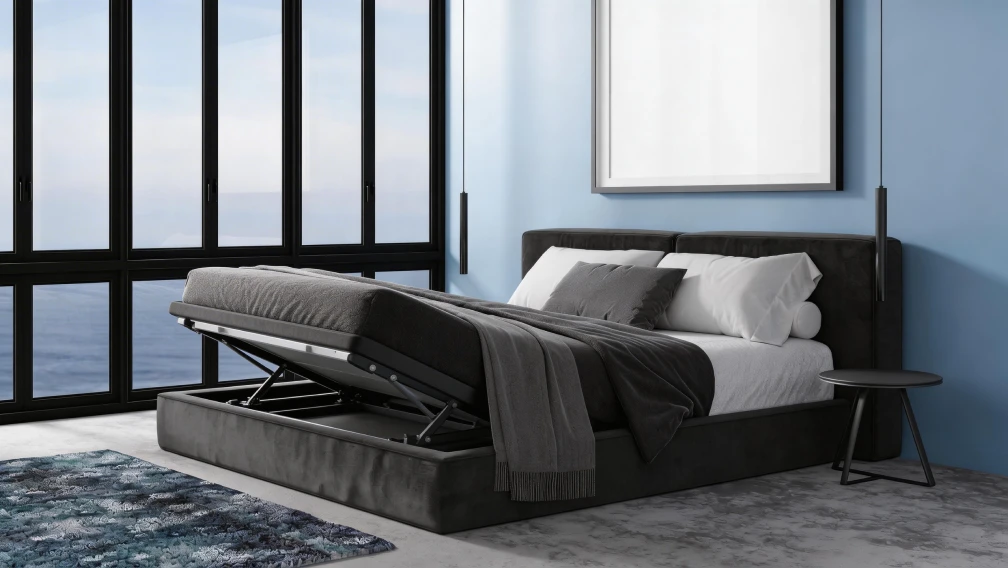
• Storage and lift frames: Storage and lift frames: on ottoman or gas-lift designs, check the gas-strut load rating and cycle life, since that mechanism is the first thing to wear. For hospitality operators running heavy-turnover environments, optimizing storage layout is a trend; you can review our hotel bed frame supplier selection insights to balanced space-saving with rigorous commercial standards.
• Packaging: flat-pack frames need a knock-down design, corner and edge protection, hardware bagged and labeled, clear instructions, and drop-tested cartons. Good packing keeps freight damage and returns down.
8. Inspection checklist
Run this before you approve a sample or release an order:
• Steel: gauge plus wall thickness in millimeters, and heavier steel in the rails, legs, and center beam.
• Joints: continuous welds with no cracks; grade 8.8-plus bolts, two per joint, with thread-lock on field joints.
• Capacity: a third-party load-test report with method and results, plus confirmation of batch testing.
• Support: center legs to the floor (two on heavy-duty), six or more total legs, steel feet.
• Slats: 2 to 3 inch spacing, hardwood or steel, held in place.
• Noise: rubber or felt pads at contacts, rubberized feet, slat retention.
• Finish: pretreatment confirmed, target film thickness, adhesion test, salt-spray hours.
• Packaging: knock-down design, protected corners, drop-tested cartons, labeled hardware.
Then do the hands-on checks: have a heavy person sit, lie, and bounce on the sample for solidity and noise; sit hard on the edge to see if it twists; and keep one unit assembled in the office for a few months to see if it loosens or starts to squeak.
9. Sourcing metal bed frames with us
We manufacture metal bed frames — platform, folding, and storage — along with the steel frames under our smart adjustable bed bases, to US sizing, with welded load-bearing joints, center support, anti-squeak detailing, and a powder-coated finish. We can share load-test reports and coating specs on request. Send your channel and target volume and we will spec the build to match.
10. FAQ
What gauge steel is best for a metal bed frame?
14-gauge suits most homes — a queen holds about 1,500 to 2,000 pounds distributed. Go to 12-gauge for heavy users or contract use, and 16-gauge only for lighter single sleepers. A lower gauge number means thicker steel.
Are welded bed frames better than bolted ones?
Welded joints hold up better under repeated load. Flat-pack frames have to bolt at some points, so look for welded load-bearing sub-assemblies and grade 8.8-plus bolts with thread-lock at the field joints.
How much weight should a metal bed frame hold?
Entry frames are built for 400 to 600 pounds total; sturdy and contract frames run 800 pounds and up. Confirm whether the number includes the mattress and bedding, and ask for a load-test report.
Why do metal bed frames squeak, and how is it prevented?
Squeaks come from metal-on-metal contact, frame flex, or slats rubbing. Welded joints, tight-fitting connections, rubber or felt pads, rubberized feet, and slat retention design the noise out.
Is powder coating better than paint for bed frames?
Yes. Powder coat is harder, more chip- and corrosion-resistant, and flexes without cracking. Quality depends on surface prep, pretreatment, full cure, and even coverage, not just the powder itself.
What slat spacing does a metal bed frame need?
2 to 3 inches or less, which most mattress warranties require. Do not add a solid plywood sheet, since it blocks airflow and traps moisture.
How long do metal bed frames last?
A well-built powder-coated steel frame lasts around 15 to 20 years and holds its capacity over time, longer than most wood frames.
How do I verify a supplier’s weight-capacity claim?
Ask for a third-party load-test report with the lab, date, sample size, method, and results, and confirm the factory tests production batches, not only prototypes. Then sit, bounce, and edge-load a sample yourself.
-

Author
Seemoon
Seemoon is a Senior Product Expert and Sleep Ergonomics Specialist. With extensive experience in the design and manufacturing of adjustable beds and smart sleep solutions, Seemoon is dedicated to sharing authoritative insights on furniture innovation, ergonomic health, and global B2B sourcing trends. All content is grounded in authentic manufacturing expertise to help global buyers make informed decisions.