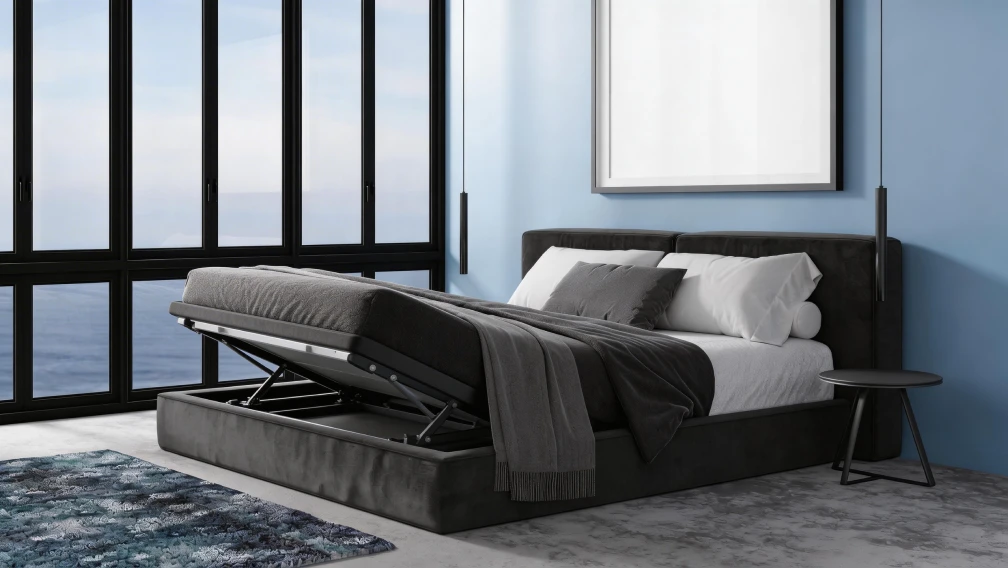

The split king adjustable bed has become the fastest-growing product segment in the North American adjustable bed market. For furniture retailers, e-commerce sellers, and wholesale distributors, understanding the differences between split king and standard king adjustable bed configurations is not optional — it directly affects product sourcing decisions, inventory planning, and how effectively you can serve the couples market.
This guide breaks down the structural, functional, and commercial differences between split king and standard king adjustable beds. It covers motor configurations, mattress compatibility, shipping logistics, price positioning, and the practical considerations that matter when you are sourcing these products at scale.
1. What Is a Split King Adjustable Bed and How Does It Differ from a Standard King?
A standard king adjustable bed base is a single platform measuring approximately 76 × 80 inches (193 × 203 cm). One motor system controls the entire sleeping surface. When one user raises the head section, the entire bed adjusts uniformly. Both sleepers share the same incline angle, foot elevation, and preset positions.
A split king adjustable bed base consists of two independent Twin XL platforms, each measuring approximately 38 × 80 inches (97 × 203 cm), placed side by side within a king-size bed frame or used freestanding together. Each side has its own motor system, remote control, and preset memory. Two sleepers can independently adjust their head incline, foot elevation, and massage settings without affecting the other side.
The distinction matters commercially because split king configurations command a higher retail price point, solve a specific consumer pain point (partner sleep compatibility), and require different sourcing, packaging, and logistics planning compared to standard king bases. From a manufacturing perspective, a split king system is essentially two Twin XL adjustable bases sold as a pair — but marketed and packaged as a king-size product.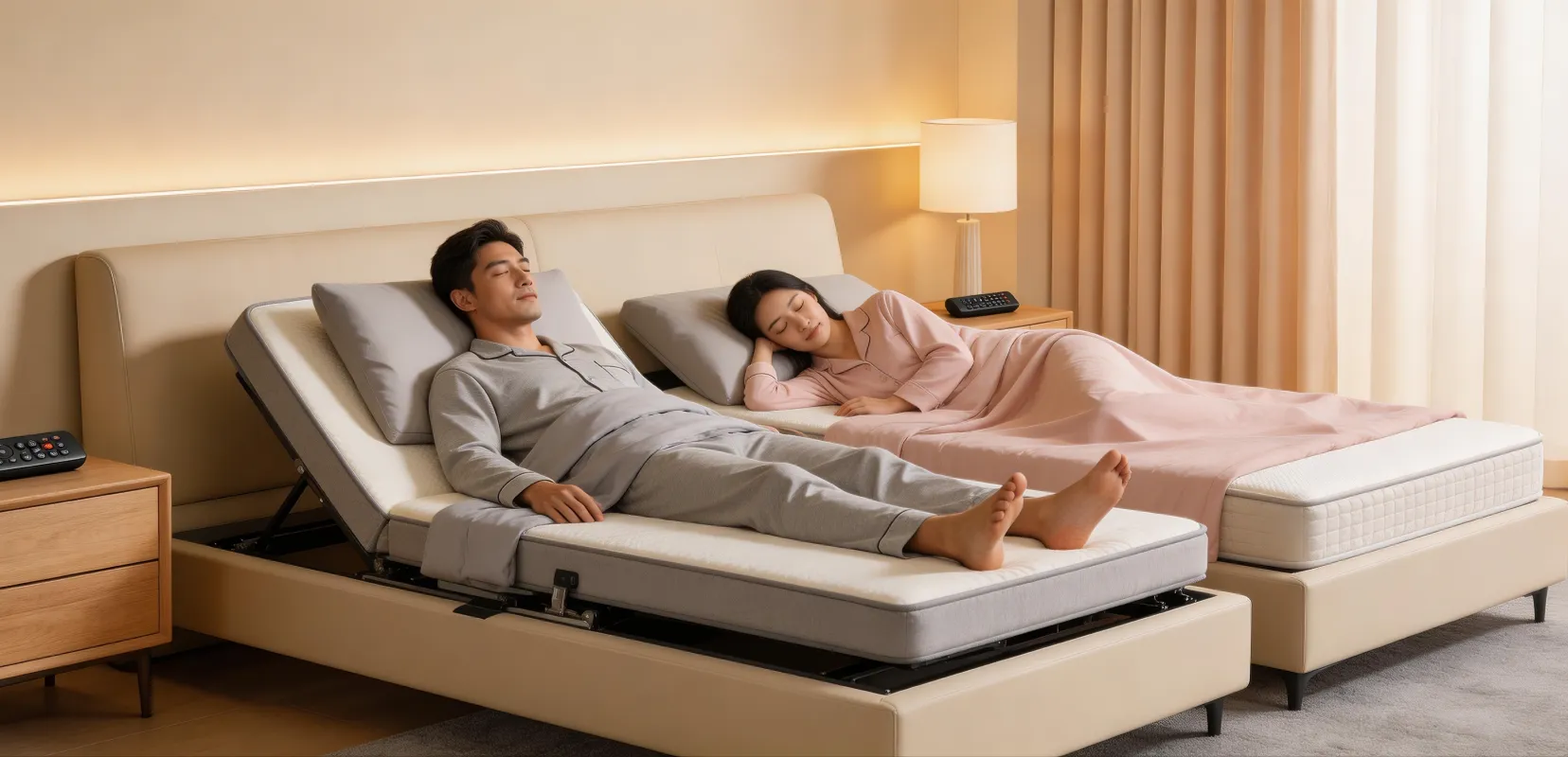
2. Split King Electric Bed Base: Motor Configurations and Feature Differences
Both split king and standard king adjustable beds are available in dual-motor, three-motor, and quad-motor configurations. However, the motor count applies per side in a split king setup, which means a split king system contains twice the total motor count of a standard king.
A dual-motor split king adjustable bed base uses two motors per side — four motors total for the complete king system. Each side independently controls head and foot articulation. This is the most common split king configuration for mid-range retail.
A three-motor split king adds lumbar support to each side, bringing the total motor count to six. This configuration targets brands positioning in the premium comfort segment.
A quad-motor split king provides four adjustment zones per side — head, pillow tilt, lumbar, and foot — for a total of eight motors across the complete system. We offer various configurations, including four-motor electric adjustable beds, used in high-end retail and healthcare-adjacent applications.
The feature set on each side of a split king mirrors what is available on a standard adjustable base of the same motor configuration: wireless remote control, zero-gravity positioning, massage functions, USB charging, under-bed LED lighting, and wall-hugger design. The difference is that each side operates independently.
| Feature | Standard King | Split King (per side) | Split King (total system) |
| Motors (dual config) | 2 | 2 | 4 |
| Motors (quad config) | 4 | 4 | 8 |
| Remote controls | 1 | 1 per side | 2 |
| Independent head adjustment | No | Yes | Yes |
| Independent foot adjustment | No | Yes | Yes |
| Independent massage | No | Yes | Yes |
| Zero-gravity preset | Whole bed | Per side | Per side |
| Mattress type | 1 king mattress | 2 Twin XL mattresses | 2 Twin XL mattresses |
| Weight capacity | 750–850 lbs total | 750–850 lbs per side | 1,500–1,700 lbs total |
3. Adjustable Bed Sizes: Standard King, Split King, and Split California King Compared
The adjustable bed market in North America uses standardized sizing that aligns with mattress industry dimensions. Understanding these sizes is necessary for accurate product sourcing, packaging specifications, and mattress compatibility guarantees.
A standard king adjustable base is a single unit measuring 76 × 80 inches. It uses one king-size mattress.
A split king adjustable bed consists of two Twin XL bases, each 38 × 80 inches. When placed together, they form the same 76 × 80 inch king footprint. Each side uses a separate Twin XL mattress.
A California king adjustable base measures 72 × 84 inches — narrower but longer than a standard king. The split California king version uses two 36 × 84 inch halves.
A split queen adjustable bed uses two 30 × 80 inch halves to form a 60 × 80 inch queen footprint. This configuration is less common than split king but growing in demand.
For retailers and distributors, the key logistics consideration is that a split king ships as two separate units per set. This affects container loading calculations, warehouse storage, and the number of SKUs required to maintain inventory. A standard king is one SKU per base; a split king requires either a paired SKU or two individual SKUs that must be sold together.
4. Who Buys Split King Adjustable Beds? Market Demand and Consumer Segments
Split king adjustable beds primarily serve couples who have different sleep preferences or health requirements. The core consumer segments include couples where one partner snores (anti-snore head elevation on one side only), couples with different comfort preferences (one prefers flat, the other prefers elevated), older adults where one partner has acid reflux or respiratory issues, and couples where one partner reads or watches TV in bed while the other sleeps.
From a retail perspective, split king adjustable beds typically sell at a 30–60% premium over standard king adjustable bases, depending on the motor configuration and feature set. This premium reflects the additional motors, electronics, and packaging required, but also the higher perceived value of independent control.
E-commerce channels have been the primary growth driver for split king adjustable bed sales. The product lends itself well to content marketing — sleep optimization, partner compatibility, health benefits — which creates organic search traffic and conversion opportunities that standard bed frames do not generate.
For wholesale distributors supplying brick-and-mortar retailers, split king adjustable beds require floor sample displays that demonstrate the independent control feature. Retailers who effectively demo split king functionality report higher conversion rates compared to standard king displays.
The demographic trend supporting split king demand is also worth noting for sourcing planning purposes. The primary buyer demographic for split king adjustable beds — couples aged 45 to 70 — is the fastest-growing segment in the US mattress replacement market. As the baby boomer generation ages and becomes more focused on sleep health, the addressable market for split king systems continues to expand. This is not a short-term trend; it is a demographic shift that will sustain demand for split king adjustable beds through at least the next decade.
For e-commerce sellers specifically, split king adjustable beds generate strong organic search traffic because the product category intersects with health-related search intent. Consumers searching for solutions to snoring, acid reflux, back pain, and partner sleep disturbance frequently discover split king adjustable beds through informational content. This creates a natural content marketing funnel that is difficult to replicate with standard bed frames or mattress products.
The retail data also shows that split king customers tend to be less price-sensitive than standard king buyers. The willingness to invest in independent sleep control indicates a consumer who prioritizes comfort and health outcomes over minimizing purchase cost. This consumer profile supports premium pricing strategies and higher-margin product configurations with massage, Bluetooth control, and advanced preset features.
5. Mattress Compatibility for Split King Adjustable Bed Systems
Mattress selection is a critical consideration for split king adjustable bed systems. Because each side articulates independently, the mattress on each side must be flexible enough to bend with the adjustable base without structural damage.
Memory foam mattresses are the most common pairing with split king adjustable beds. Foam construction bends smoothly with the base articulation and returns to its original shape. Most memory foam mattresses between 8 and 14 inches thick are compatible.
Latex mattresses also work well with adjustable bases due to their natural flexibility and resilience. Both natural and synthetic latex bends with the base without permanent deformation.
Hybrid mattresses — those combining foam layers with pocketed coil springs — are compatible with adjustable bases if the coils are individually wrapped. Bonnell coil or connected coil mattresses are generally not recommended for adjustable bases.
Innerspring mattresses with connected coil systems are the least compatible with adjustable bases. The rigid coil structure resists bending and can be permanently damaged by repeated articulation.
For split king configurations specifically, each side uses a separate Twin XL mattress. This means two sleepers can use different mattress types or firmness levels — one side can have a firm memory foam while the other has a soft latex, for example. This is an additional selling point that standard king configurations cannot offer.
Retailers and distributors sourcing split king adjustable beds should consider offering mattress-and-base bundles. Bundled packages simplify the consumer purchase decision and increase average order value. From a sourcing perspective, OEM manufacturers can often supply adjustable bases and compatible mattresses from the same factory or coordinated supply chain.
6. Shipping, Packaging, and Container Loading: Split King vs Standard King Logistics
The logistics of shipping split king versus standard king adjustable beds affect landed cost, warehouse handling, and e-commerce fulfillment in ways that directly impact profitability.
A standard king adjustable bed base ships as a single unit in one carton. Typical carton dimensions are approximately 44 × 16 × 12 inches (110 × 40 × 30 cm) for a center-folding model. A 40-foot container can hold approximately 280–350 standard king bases depending on the specific packaging configuration.
A split king adjustable bed ships as two separate Twin XL units. Each unit is packaged in its own carton, with dimensions approximately 42 × 15 × 11 inches (107 × 38 × 28 cm). Because the individual Twin XL cartons are smaller than a king carton, they can sometimes achieve better container utilization — but you need two cartons per complete system, so the total volume per king-equivalent set is roughly 15–25% larger than a single king base.
For e-commerce fulfillment, split king systems create a specific challenge: the two cartons must ship together or arrive within the same delivery window. If one carton arrives and the other is delayed, customer satisfaction drops. Fulfillment centers must either band the two cartons together or use paired shipment tracking.
From a warehousing perspective, split king inventory takes more floor space per king-equivalent set and requires paired picking processes. Retailers should factor this into their total landed cost calculations when comparing split king versus standard king sourcing economics.
Container loading calculations illustrate the logistics difference in concrete terms. If a 40-foot container holds 320 standard king adjustable bases, the same container holds approximately 340 Twin XL bases — which translates to only 170 complete split king systems. This means you need roughly twice the container volume to ship the same number of king-equivalent sleep sets in split king configuration. For distributors managing tight warehouse space and seasonal inventory builds, this loading difference affects purchasing cadence and storage planning.
The return logistics for split king systems also deserve consideration. If a consumer returns a split king set, both units must be received, inspected, and processed together. If only one unit is returned (due to a defect on one side, for example), the remaining unit is orphaned inventory — a single Twin XL base that cannot be sold as a split king component unless matched with a replacement. Some distributors address this by maintaining a small buffer stock of individual Twin XL units for warranty replacements.
7. Price Positioning and Margin Analysis: Standard King vs Split King Adjustable Base
Split king adjustable beds occupy a higher price tier than standard king bases, but the margin structure differs in ways that affect sourcing decisions.
Manufacturing cost for a split king system is approximately 70–90% higher than a standard king base of the same motor configuration. This is because a split king is essentially two complete Twin XL adjustable bases — doubling the motors, electronics, remotes, and packaging materials.
Retail pricing, however, typically positions split king systems at only 30–60% above standard king pricing. This means that while the absolute margin per set may be higher on a split king, the margin percentage is often lower.
For distributors and retailers, the decision to stock split king inventory involves balancing higher absolute margins against higher per-unit capital requirements, larger inventory footprint, and more complex fulfillment logistics. The growing consumer demand for split king configurations generally justifies the additional operational complexity for retailers focused on the adjustable bed category.
From an OEM sourcing perspective, split king manufacturing uses the same Twin XL production lines as standard adjustable bases. This means there is no additional tooling cost or production line setup — the manufacturer simply pairs two Twin XL units and packages them for the split king market. OEM buyers who already source Twin XL adjustable bases can add split king as a product line extension with minimal supply chain complexity.
8. How to Source Split King Adjustable Beds: OEM Considerations for Buyers
Sourcing split king adjustable beds from an OEM manufacturer involves several considerations that differ from sourcing standard adjustable bases.
First, confirm that the manufacturer produces Twin XL bases on dedicated production lines with consistent specifications. Since a split king system pairs two Twin XL units, any variance between the two bases — motor speed, frame dimensions, remote programming — will be apparent to the end consumer.
Second, verify the remote control pairing system. Some manufacturers use universal remotes that can control either side interchangeably; others use paired remotes where each remote is coded to a specific base. The pairing system affects warranty replacement procedures and customer service handling.
Third, discuss packaging options for split king sets. Some manufacturers package both Twin XL units in a single oversized carton; others ship two individual cartons with matching SKU labels. The packaging approach affects container loading efficiency, freight costs, and e-commerce fulfillment workflows.
Fourth, confirm mattress compatibility testing. If you plan to sell split king adjustable bases with specific mattress brands or types, the manufacturer should be able to verify that the base articulation range, frame dimensions, and retainer systems are compatible with your mattress specification.
For established OEM relationships, adding a split king product line is typically straightforward — it uses existing Twin XL production with paired packaging and paired SKU management. Learn more about our OEM manufacturing and production capabilities.The incremental investment is primarily in packaging design and marketing materials rather than production tooling.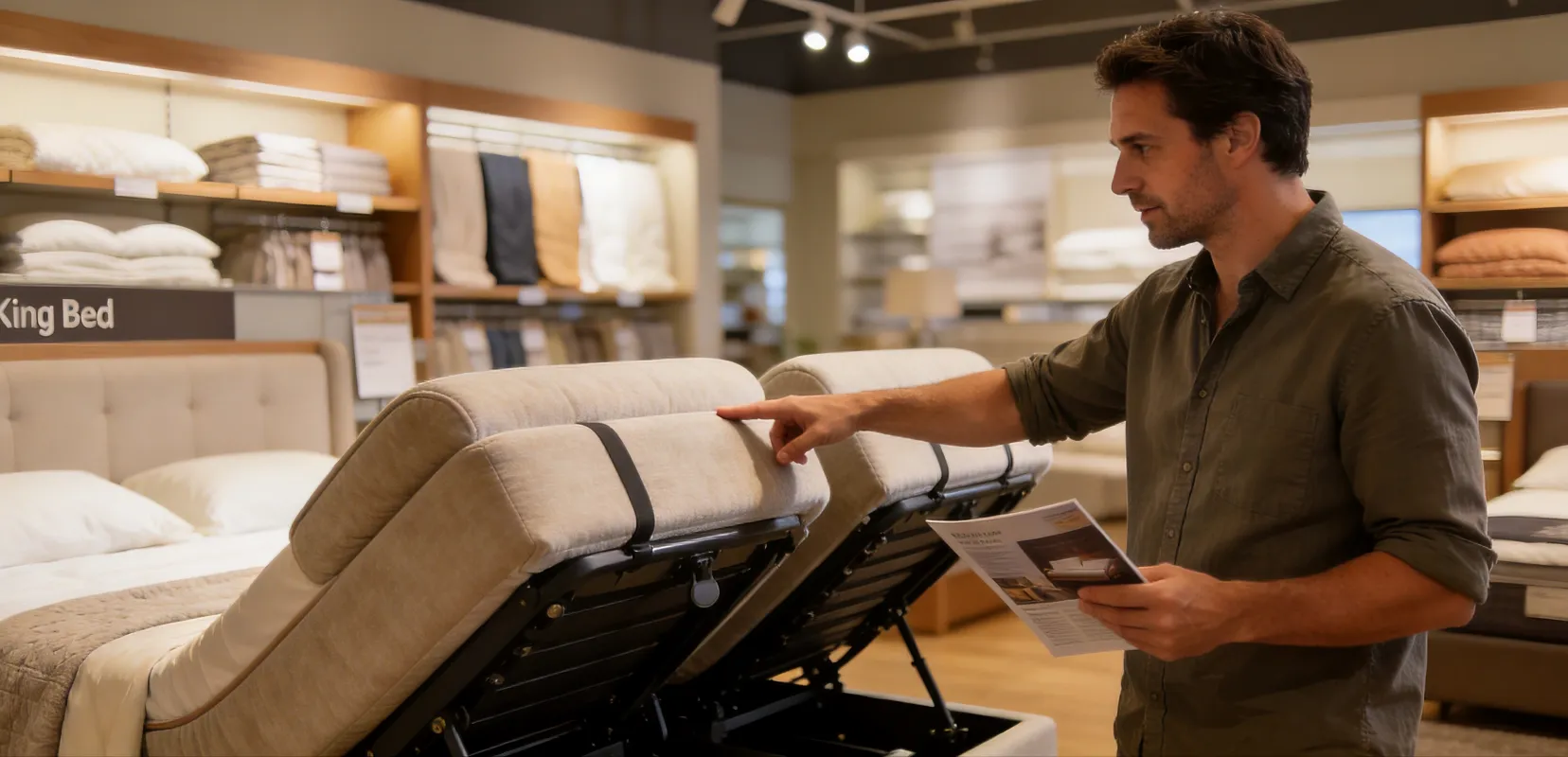
9. Adjustable Bed Base Compatibility: Mattress Foundations and Bed Frame Integration
An often-overlooked consideration in split king versus standard king sourcing is the bed frame compatibility question. Adjustable bed bases can be used freestanding on their own legs, but many consumers prefer to place them inside a traditional bed frame for a more finished bedroom appearance. This creates a product compatibility consideration that affects how you merchandise and bundle your adjustable bed products.
For standard king adjustable beds, a king-size bed frame with an open-top design (no fixed slats or crossmembers that would interfere with the base articulation) is required. The internal dimensions of the bed frame must be large enough to accommodate the adjustable base with sufficient clearance on all sides for the base to articulate without contacting the frame rails.
For split king adjustable beds, the bed frame must accommodate two side-by-side Twin XL bases. The frame must be wide enough to hold both bases without a center divider that would create a gap between the two sleeping surfaces. Some bed frame manufacturers produce king-size frames specifically designed for split king adjustable base compatibility, with internal dimensions optimized for two Twin XL units and no center crossbar.
Retailers who sell both adjustable beds and bed frames can create meaningful attachment sales by offering compatible frame-and-base packages. This increases average order value and reduces the risk of customer returns caused by incompatible frame-and-base pairings. For OEM sourcing, manufacturers who produce both adjustable beds and bed frames from the same facility can ensure dimensional compatibility and offer bundled pricing.
The search term “bed frames compatible with adjustable base” receives approximately 920 monthly searches with a keyword difficulty of 17, indicating that there is measurable consumer interest in this topic. Creating product pages and content that address adjustable base and bed frame compatibility can capture this search traffic and drive qualified leads to your product catalog.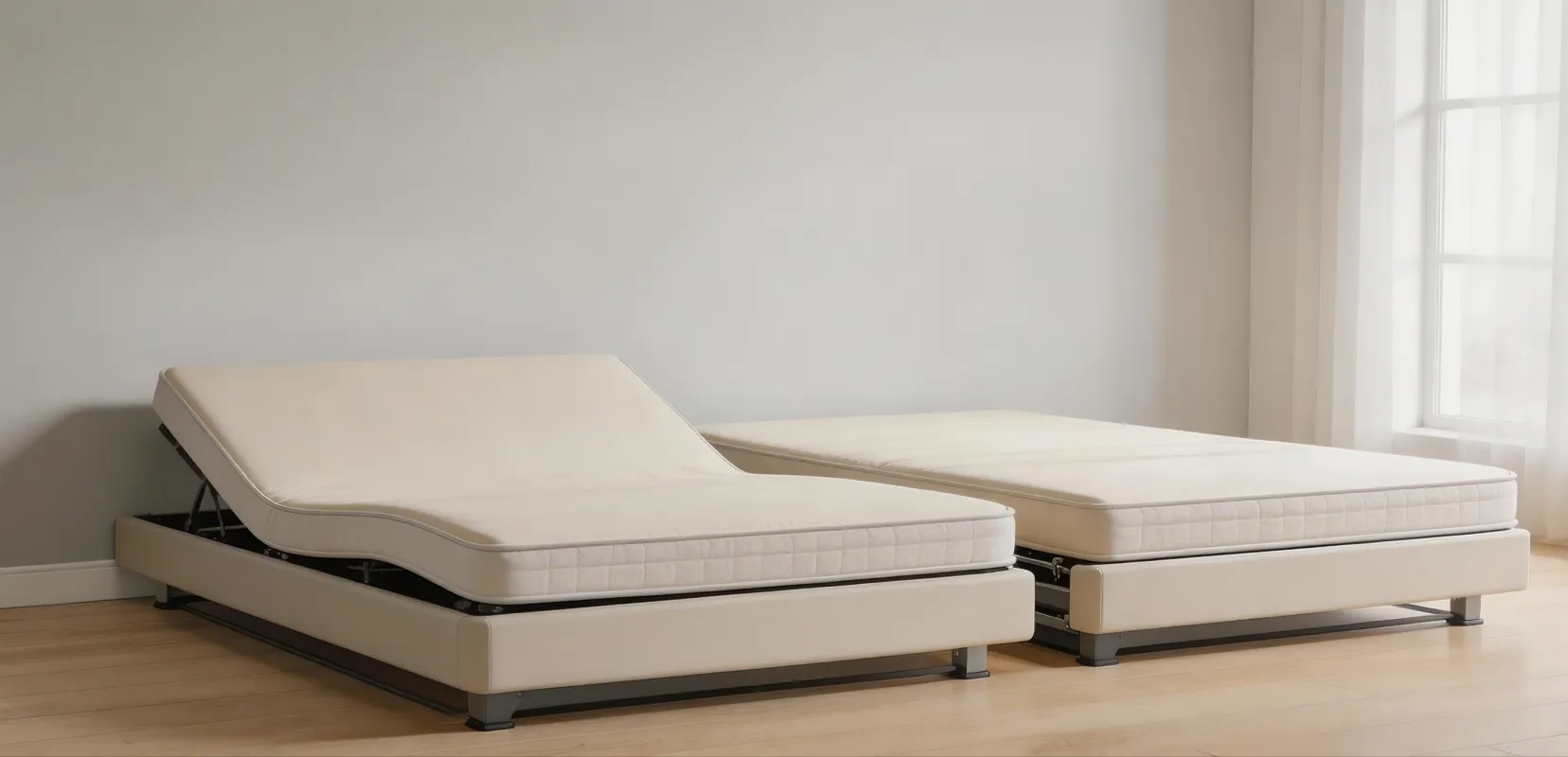
10. Choosing Between Split King and Standard King: A Decision Framework for Retailers
The decision to stock split king, standard king, or both configurations depends on your target market, retail format, and supply chain capacity.
Stock standard king only if your primary market is price-sensitive, your retail format does not support product demonstrations, or your fulfillment infrastructure cannot handle paired-shipment logistics. Standard king adjustable beds serve the entry-to-mid market effectively and require simpler inventory management.
Stock split king only if your customer base is predominantly couples in the 35-65 age range, your brand positioning emphasizes sleep health and personalization, and your e-commerce or retail floor allows effective demonstration of independent control features.
Stock both configurations if you serve a broad market, have the warehouse capacity for paired SKU management, and want to offer a good-better-best product ladder within the adjustable bed category. The standard king serves as the entry point; the split king serves as the upgrade with higher average order value.
For wholesale distributors supplying multiple retailers, carrying both configurations is generally necessary to serve the full range of retail customers in your territory.
Ready to Source Split King or Standard King Adjustable Beds?
Seemoon manufactures both standard king and split king adjustable bed bases in dual-motor, three-motor, and quad-motor configurations. As a factory-direct OEM manufacturer with over 3 million beds shipped to North America, we provide consistent production quality, competitive pricing, and full customization support for your adjustable bed program.
Whether you need standard king bases for high-volume e-commerce or split king systems for premium retail positioning, our engineering and sales teams can provide a manufacturing proposal within 48 hours.
-

Author
Seemoon
Seemoon is a Senior Product Expert and Sleep Ergonomics Specialist. With extensive experience in the design and manufacturing of adjustable beds and smart sleep solutions, Seemoon is dedicated to sharing authoritative insights on furniture innovation, ergonomic health, and global B2B sourcing trends. All content is grounded in authentic manufacturing expertise to help global buyers make informed decisions.